Arakawa staggered grid
Description
The Arakawa family is not a standalone topology — it is a stagger wrapper
around a base curvilinear grid (Cartesian or lat-lon). It assigns prognostic
variables to one of four canonical
locations per cell. The location enum (VarLocation, exported from the
package) is CellCenter, UEdge, VEdge, Corner:
VarLocation | Accessor | Variable held there | Used by |
|---|---|---|---|
CellCenter | cell_centers(grid, i, j) | scalars (mass h, pressure, tracers) | A, B, C, D, E |
UEdge | u_face(grid, i, j) | u-component of velocity | C, D, E |
VEdge | v_face(grid, i, j) | v-component of velocity | C, D, E |
Corner | corners(grid, i, j) | u, v together (B) | B |
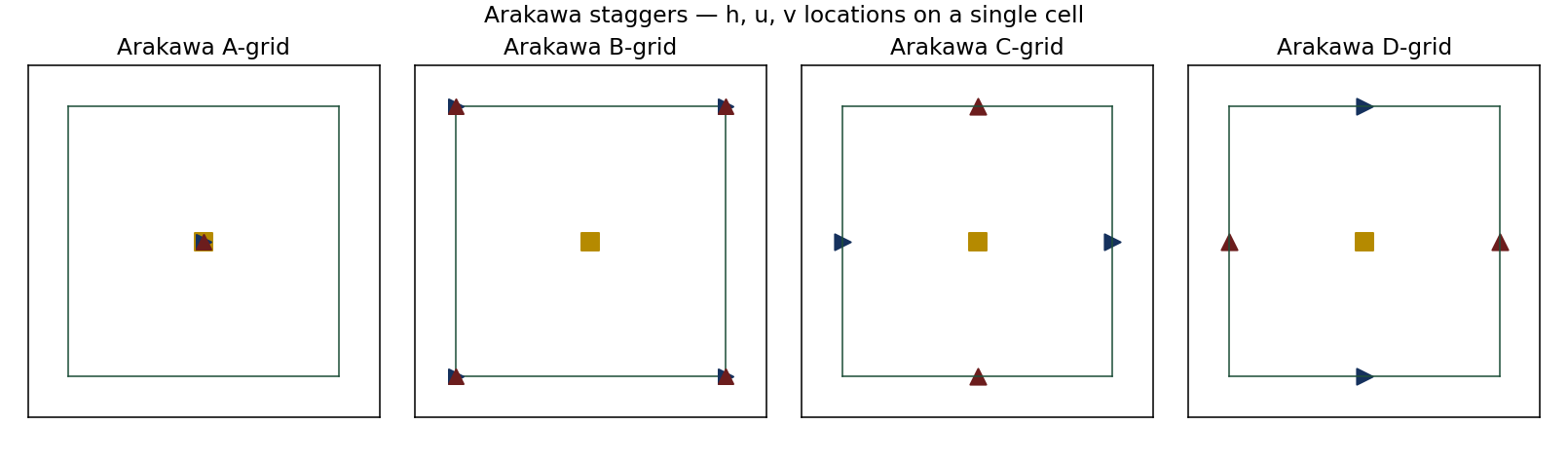
The Arakawa A/B/C/D/E distinction is just the choice of which subset of
locations carries u, v, and h (the per-stagger table lives in
arakawa_variable_locations in src/grids/arakawa.jl):
- A-grid (
ArakawaA): all variables co-located at cell centers (simple but hosts checkerboard modes for the divergence operator) - B-grid (
ArakawaB):hat center, bothuandvat corners - C-grid (
ArakawaC):hat center,uon the U-edge,von the V-edge (good for wave equations and divergence-conservative discretizations) - D-grid (
ArakawaD): dual of C —uandvswapped between the U-edge and V-edge - E-grid (
ArakawaE): rotated arrangement withuandvon edges (thestaggerparser accepts:E)
A grid is constructed via
EarthSciDiscretizations.grids.arakawa(; base, stagger, ghosts, dtype),
where stagger is one of :A, :B, :C, :D, :E and base is the
underlying Cartesian or lat-lon grid.
ESD currently seeds the C-grid via the
divergence_arakawa_c rule, which
demonstrates the stagger_enum / requires_locations / emits_location
fields used to make stagger-position selectors authoritative in the rule
schema.
Visualization
Trait coverage
Registered against AbstractStaggeredGrid (which sits beneath
AbstractCurvilinearGrid). The base-grid trait calls all delegate to the
underlying Cartesian / lat-lon implementation; stagger-aware accessors —
cell_centers, u_face, v_face, corners — return the coordinate at
the location where each prognostic variable lives for the chosen stagger.
See also
divergence_arakawa_c- Arakawa & Lamb (1977), Methods in Computational Physics 17:173–265
discretizations/SELECTOR_KINDS.md