Cartesian
Description
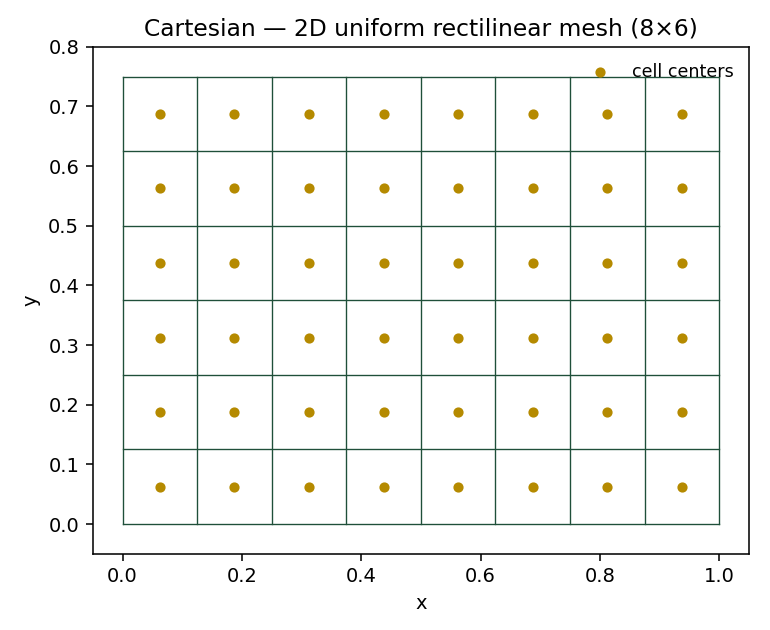
The Cartesian grid is the simplest curvilinear topology ESD supports: a logically
rectangular mesh of cells whose coordinates are an outer product of per-axis edge
arrays. Each axis can be uniform (single-step dx) or non-uniform (arbitrary
1D edge array). Dimensionality is 1 / 2 / 3 (axes named x, y, z).
The on-disk .esm form is a small declarative config — family, n[],
extent[], uniform[] — not a serialized geometry blob. The runtime accessor
in src/grids/cartesian.jl derives cell_centers, cell_widths, cell_volume,
and neighbor_indices from that declaration via pure math.
Visualization
Trait coverage
The Cartesian family registers against AbstractCurvilinearGrid and supplies
the full Tier-C bulk-array contract: cell_centers, cell_widths,
cell_volume, neighbor_indices, boundary_mask, n_cells, n_dims,
axis_names. Because the metric tensor is identity, metric_g, metric_ginv,
metric_jacobian, and metric_dgij_dxk short-circuit to constant arrays.
Canonical fixtures
discretizations/grids/cartesian/uniform_1d_n64.esm— N=64 uniform 1D mesh