Duo (geodesic triangular)
Description
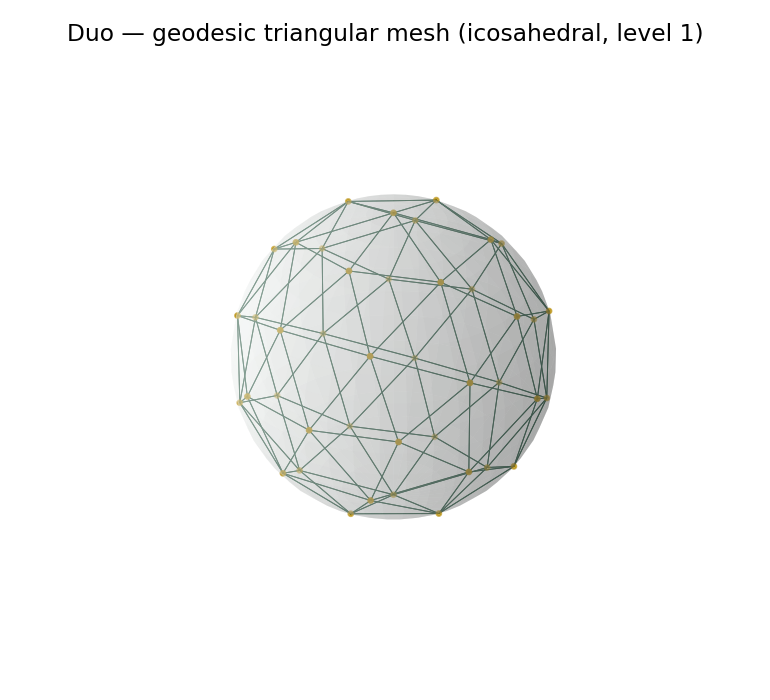
The duo family is a geodesic triangular mesh — a recursively-bisected
icosahedron projected onto the sphere. At level L, each of the 20
icosahedral seed faces is subdivided into 4ᴸ triangles, giving 20·4ᴸ
triangles, 30·4ᴸ edges, and 2 + 10·4ᴸ vertices.
The mesh is unstructured (no (i, j) indexing) but enjoys topological
regularity: every interior vertex has 6 incident edges and the only
“defects” are the 12 vertices inherited from the icosahedron, which have
5 edges. This makes it a popular target for shallow-water and barotropic
codes that want a uniform sphere coverage without the cubed-sphere panel
seams.
Visualization
Trait coverage
Registered against AbstractUnstructuredGrid. Adjacency arrays are
vertices_on_face, edges_on_face, and faces_on_vertex; bulk geometry
is the per-vertex Cartesian-on-sphere position and per-edge arc length.
Canonical fixtures
discretizations/grids/duo/icos_level0.esm— 20 faces, 12 vertices (the seed)discretizations/grids/duo/icos_level1.esm— 80 faces, 42 verticesdiscretizations/grids/duo/icos_level2.esm— 320 faces, 162 vertices