centered_2nd_uniform
Lowering
The rule is the canonical exemplar of an ESD linear scheme that lowers a
§4.2 PDE operator to a closed arrayop expression in the §4.2 op
vocabulary. There are no scheme-specific coefficient blobs and no
off-spec selector / offset fields — applies_to matches against grad
(itself a §4.2 op), and the lowering is a single arrayop whose body
combines index, +, -, *, and /. ESS bindings (any binding) can
evaluate the lowering by walking the AST.
applies_to:  grad(u, dim=x)
replacement: arrayop(
               output_idx = [$x],
               expr       = (index($u, $x+1) − index($u, $x−1)) / (2·dx),
               args       = [$u]
             )
After pattern-variable substitution ($u → u, $x → i), the lowering at
each interior cell reduces to
Boundary conditions
Boundary handling is read from the domain’s boundary_conditions block
(esm-spec §11.5) at lowering time and applied as downstream rewrite
rules over concrete indices — there is no bc:* op embedded in the
lowered AST. The pattern is:
| Domain BC | Index transformation applied to $u[$x ± 1] |
|---|---|
periodic | mod($x ± 1 + N, N) (see periodic_bc) |
dirichlet / constant | Boundary cells read the prescribed value via index into a fill row |
zero_gradient / neumann | Mirror the in-range neighbor (min/max clamp on the index) |
Each transformation is a separate rule that fires at the boundary cells.
The centered_2nd_uniform rule itself stays BC-agnostic — its
replacement is the interior closed form. The lowering pipeline (rule
application + BC rewrites) takes the (grid_family, BC list) pair from
the domain and emits index expressions that respect the declared BCs.
Truncation derivation
Symmetric Taylor expansion of the two neighbors about \(x_i\),
$$u_{i\pm 1} \;=\; u_i \;\pm\; \Delta x\,u'_i \;+\; \tfrac{\Delta x^{2}}{2}\,u''_i \;\pm\; \tfrac{\Delta x^{3}}{6}\,u'''_i \;+\; \tfrac{\Delta x^{4}}{24}\,u^{(4)}_i \;\pm\; \cdots,$$cancels the even-order terms when subtracted, giving
$$\frac{u_{i+1} - u_{i-1}}{2\,\Delta x} \;=\; u'_i \;+\; \tfrac{\Delta x^{2}}{6}\,u'''_i \;+\; O(\Delta x^{4}).$$The scheme is therefore second-order accurate, with a purely dispersive
leading error \(\tfrac{\Delta x^{2}}{6}\,u'''(x)\) and no numerical
diffusion — contrast with upwind_1st,
whose one-sided stencil introduces an explicit diffusive
\((\Delta x / 2)\,u''(x)\) term.
Convergence
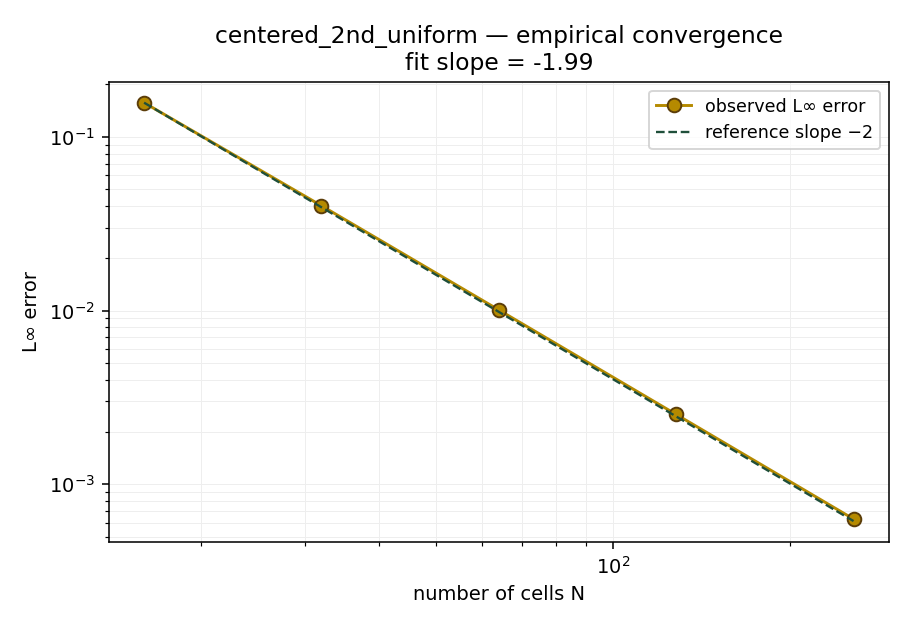
u(x) = sin(2πx)
on a periodic [0, 1] domain, sampled at cell centers. Empirical slope
matches the expected −2 reference line.The fixture under
discretizations/finite_difference/centered_2nd_uniform/fixtures/convergence/
sets expected_min_order = 1.9 to tolerate minor pre-asymptotic drift on
the 16 → 32 → 64 → 128 sequence. ESS’s mms_convergence walks the
replacement-form rule through its arrayop / broadcast evaluator (no
scheme-specific kernels), so the sweep runs directly against the closed
§4.2 lowering described above.