weno5_advection
Lowering
The rule is the canonical exemplar of an ESD nonlinear scheme that
lowers a §4.2 PDE operator to a closed arrayop expression in the
§4.2 op vocabulary — the sibling of
centered_2nd_uniform for
linear schemes. There are no scheme-specific coefficient blobs and no
off-spec match keys: applies_to matches against div (a §4.2 op)
applied to the advective flux *($U, $q), and the lowering is a single
arrayop whose body combines index, +, -, *, /, ^, and
ifelse. ESS bindings (any binding) can evaluate the lowering by
walking the AST through the existing arrayop / broadcast evaluator —
no new kernels.
applies_to:  div(*($U, $q), dim=x)
replacement: arrayop(
               output_idx = [$x],
               expr       = (F_E − F_W) / dx,
               args       = [$U, $q]
             )
The face flux F = U_face · q^upwind is built from a cell-to-face
average of U and a Jiang–Shu (1996) WENO5 reconstruction of q.
Upwinding is encoded directly in the AST as
with the cell-to-face velocity average $U_{i+1/2} = \tfrac12(U_i + U_{i+1})$ and a symmetric expression at the west face. The right-biased reconstruction $q^{R}$ is the same closed WENO5 expression evaluated on the mirrored 5-cell stencil (Shu 1998 §2.2 eq. 2.16) — the algebra is identical, only the input order differs.
Reconstruction (Jiang–Shu 1996)
For face $x_{i+1/2}$ with $U_{i+1/2} > 0$, the left-biased reconstruction is the convex combination
$$q^{L}_{i+1/2} \;=\; \omega_0 p_0 + \omega_1 p_1 + \omega_2 p_2,$$of three candidate sub-stencil polynomials evaluated at the face (Shu 1998 eq. 2.11):
| sub-stencil | offsets | polynomial $p_k(q)$ |
|---|---|---|
p₀ | (−2, −1, 0) | $\tfrac{1}{3}q_{i-2} - \tfrac{7}{6}q_{i-1} + \tfrac{11}{6}q_i$ |
p₁ | (−1, 0, +1) | $-\tfrac{1}{6}q_{i-1} + \tfrac{5}{6}q_i + \tfrac{1}{3}q_{i+1}$ |
p₂ | (0, +1, +2) | $\tfrac{1}{3}q_i + \tfrac{5}{6}q_{i+1} - \tfrac{1}{6}q_{i+2}$ |
The nonlinear weights $\omega_k$ are normalized smoothness-weighted versions of the optimal linear weights $(d_0, d_1, d_2) = (1/10, 6/10, 3/10)$:
$$\beta_0 = \tfrac{13}{12}(q_{i-2}-2q_{i-1}+q_i)^2 + \tfrac14(q_{i-2}-4q_{i-1}+3q_i)^2,$$ $$\beta_1 = \tfrac{13}{12}(q_{i-1}-2q_i+q_{i+1})^2 + \tfrac14(q_{i-1}-q_{i+1})^2,$$ $$\beta_2 = \tfrac{13}{12}(q_i-2q_{i+1}+q_{i+2})^2 + \tfrac14(3q_i-4q_{i+1}+q_{i+2})^2,$$ $$\alpha_k = \frac{d_k}{(\varepsilon + \beta_k)^2}, \qquad \omega_k = \frac{\alpha_k}{\sum_j \alpha_j}.$$Every term above appears in the rule’s replacement AST as +, -,
*, /, and ^ over index selectors — there is no
smoothness_indicators blob, no nonlinear_weights blob, and no
ratio-form ω that has to live outside the AST.
Boundary conditions
Boundary handling is read from the domain’s boundary_conditions block
(esm-spec §11.5) at lowering time and applied as downstream rewrite
rules over concrete indices — there is no bc:* op embedded in the
lowered AST. The pattern is:
| Domain BC | Index transformation applied to $q[$x ± k], $U[$x ± k] |
|---|---|
periodic | mod($x ± k + N, N) (see periodic_bc) |
dirichlet / constant | Boundary cells read the prescribed value via index into a fill row |
zero_gradient / neumann | Mirror the in-range neighbor (min/max clamp on the index) |
Each transformation is a separate rule that fires at the boundary
cells. The weno5_advection rule itself stays BC-agnostic — its
replacement is the interior closed form. The lowering pipeline (rule
application + BC rewrites) takes the (grid_family, BC list) pair from
the domain and emits index expressions that respect the declared BCs.
Stencil
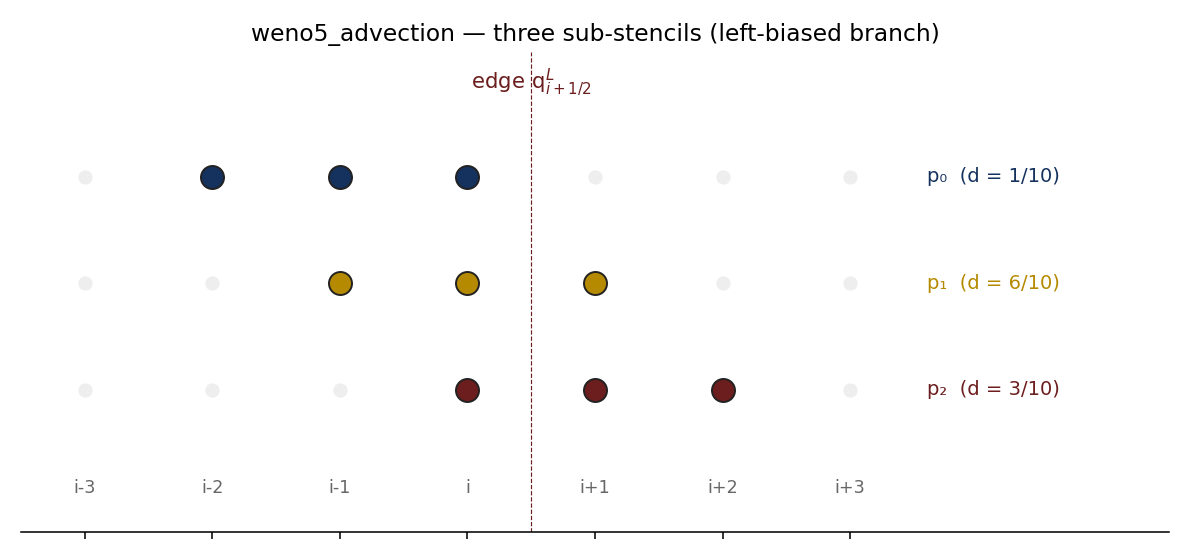
qi+1/2L.
Linear weights (d₀, d₁, d₂) = (1/10, 6/10, 3/10) recover formal
5th-order accuracy in smooth regions; nonlinear weights ωk shift
away from sub-stencils that straddle a discontinuity.For a single divergence at cell i, the closed AST reads from cells
i−3, …, i+3 (seven cells) for q — five per face — and from cells
i−1, i, i+1 for the cell-to-face velocity average. The right-biased
branch (used when U_face < 0) is the mirror of the left-biased branch
under index reflection.
Convergence
Numeric coverage lives in the canonical Julia test fixture at
tests/fixtures/weno5_advection/,
exercised by
test/test_weno5_advection_rule.jl.
The MMS fixture uses f(x) = sin(2πx + 1) on [0, 1] with periodic boundary
conditions; the phase shift keeps the critical points of f away from every
dyadic cell face at n ∈ {32, 64, 128, 256}, sidestepping the well-known
WENO5-JS accuracy dip from ω_k → d_k recovery stalling at
f'(x_{i+1/2}) = 0 (Henrick, Aslam & Powers, JCP 2005).
n | dx | L∞ error | observed order |
|---|---|---|---|
| 32 | 0.03125000 | 3.4137e-05 | — |
| 64 | 0.01562500 | 1.0656e-06 | 5.002 |
| 128 | 0.00781250 | 3.3254e-08 | 5.002 |
| 256 | 0.00390625 | 1.0377e-09 | 5.002 |
Theoretical asymptotic order: 5.0 (Jiang & Shu 1996, smooth regions).
Acceptance threshold: min(observed order) ≥ 4.7 — leaves headroom for the
small accuracy hit from the ε = 1e-6 regularisation of the nonlinear
weights. A companion shock-capturing fixture advects a unit square wave one
full period at CFL 0.4 with SSP-RK3; max overshoot/undershoot is ~3.7e-4,
well under the 0.05 tolerance.
The walker-side fixture under
discretizations/finite_volume/weno5_advection/fixtures/convergence/
exercises Layer-B convergence through ESS’s AST-walker dispatch over the
closed arrayop + ifelse replacement — no scheme-specific kernels.