weno5_advection_2d
Stencil
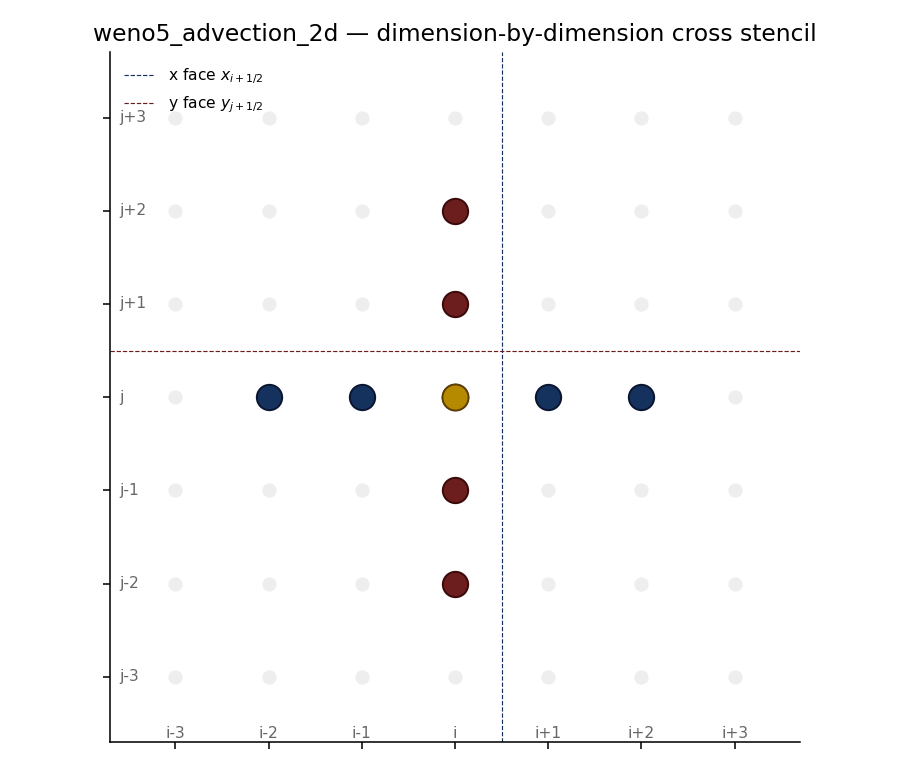
(i,j). Each axis carries the three candidate sub-stencils of
the 1D rule. The union spans nine cells per axis (five own-axis +
four cross-axis), 17 of the 5×5 neighborhood total.Coefficients
Per-axis blocks under axes.x / axes.y reuse the 1D
weno5_advection
sub-stencils, linear weights (d₀, d₁, d₂) = (1/10, 6/10, 3/10), and
smoothness indicators (Jiang & Shu 1996 eq. 2.17), with the selector axis
swapped between $x and $y. Nonlinear weights α_k = d_k / (ε + β_k)²,
normalized to ω_k = α_k / Σ α_j. The right-biased branch (used when the
local face velocity is negative) is the index-reflected mirror of the
left-biased branch.
The flux selection per axis is upwinded against the local face velocity:
$$ F^x_{i+1/2,j} = u_{i+1/2,j}\, q_{i+1/2,j}^{\mathrm{upwind}},\qquad F^y_{i,j+1/2} = v_{i,j+1/2}\, q_{i,j+1/2}^{\mathrm{upwind}}. $$The advective tendency sums the two axis flux divergences:
$$ \mathrm{advect}(q, U) = \frac{F^x_{i+1/2,j} - F^x_{i-1/2,j}}{\Delta x} \,+\, \frac{F^y_{i,j+1/2} - F^y_{i,j-1/2}}{\Delta y}. $$Convergence
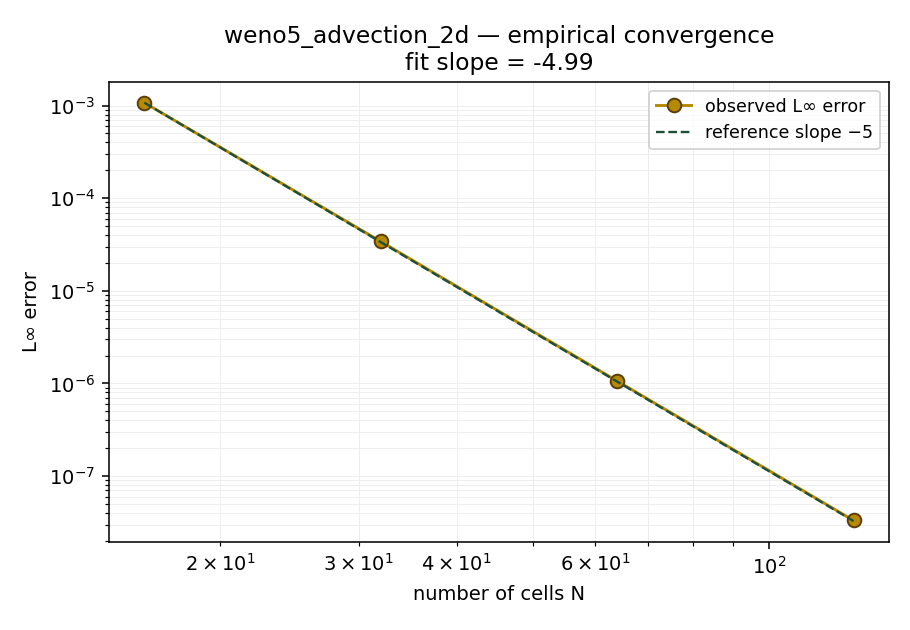
u(x,y) = sin(2π x + 1)·sin(2π y + 1/2) on
[0,1]² periodic, reconstructed face values vs the analytic
cross-section averages. Slope ≈ 5.0; sub-5th order is recovered in the
asymptotic regime.The numeric coverage lives in the Layer-B convergence fixture —
discretizations/finite_volume/weno5_advection_2d/fixtures/convergence/
— which declares expected_min_order = 4.5 on
n ∈ {32, 64, 128, 256} with the separable phase-shifted sine
product MMS u(x,y) = sin(2π x + 1)·sin(2π y + 1) on
[0,1]² periodic, matching the floor cited by Shu (1998) §2.2
with a small allowance for the ε-regularised nonlinear-weight transition.
Theoretical asymptotic order: 5.0 per axis (Jiang & Shu 1996, smooth
regions; Shu 1998 §2.2 dimension-by-dimension splitting; LeVeque 2002 §20).
Acceptance threshold: min(observed order) ≥ 4.5 across the
n ∈ {32, 64, 128, 256} sweep.
The sweep is dispatched through ESS’s
mms_weno5_convergence 2D path (esm-hsa): the harness applies
the rule’s axes.x 1D sub-stencil row-wise on the cell-averaged
manufactured field and compares the reconstructed face values against the
perpendicular-axis-averaged analytic face truth. WENO5’s positive
homogeneity makes the result symmetric in x ↔ y, so verifying
one axis is sufficient for the asymptotic-order claim.